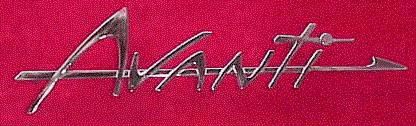
The Avanti was a major part of a plan to keep Studebaker in the automobile
business, not by its sales alone, but as a way to generate interest, get
people to the dealerships and achieve a reputation for performance and
advanced design. The plan was to introduce it at the April, 1962 New York
International Auto Show, then the Indianapolis 500 mile race, begin production of
a rate at approximately 1000 per month and produce approximately 20,000 of
the 1963 models before moving on to greater production in 1964.
Unfortunately, following the introduction, Avantis trickled out of the
factory because of problems with the fiberglass body. As a result most
Studebaker dealerships had not received their first Avanti by the September
model change-over date and 1963 model production totaled only 3,744. An
additional 795 of the 1964 model were produced before Studebaker stopped
South Bend auto production in December, 1963 and decided not to produce the Avanti
or Hawk in Canada.
Rushing the Avanti into production was a big mistake, but the Studebaker
corporate officers had little choice because the auto division lost money
most years and the shareholders were tired of that routine. The Avanti
created a lot of interest in April, 1962, but by September the big news was the
first Corvette Sting Ray and the new Buick Riviera. A 327 cu. in. Sting Ray
split-window coupe cost $4,252 ( $4,037 for the convertible) or for $4,333
you could buy a new Rivera with a 401 or 425 cu. in. V-8. Chevy sold 21,513
Sting Rays and Buick sold 40,000 Rivieras that year. An Avanti cost $4,445,
was available with only the 289 cu. in. V-8 of unknown horsepower because
Studebaker wouldn't cite any horsepower figures.
Another interesting comparison can be made to the introduction of the first
Ford Mustang, which was being developed at the same time as the Avanti. Ford
did not introduce it until April, 1964 and it appeared in the dealerships
immediately thereafter. Ford produced 121,538 Mustangs by the September
model change-over and total production for the "1964-1/2 - 1965" model was
680,989. To put the figures in perspective, Ford built 182 Mustangs for every
Avanti that Studebaker built during the first seventeen months of production
of each vehicle. The Ford Mustang was one of the greatest success stories of the
automotive industry, but the Avanti also created its own niche in automotive
history by being produced for 30 years after it was introduced and/or 25
years after its parent company went out of the automobile business. It was
the orphan car that refused to die.
After Studebaker ceased production of the Hawks and Avantis, Leo Newman and
Nate Altman, who owned one of South Bend's most successful
Studebaker-Packard dealerships, reopened part of the factory and resumed
Avanti production in 1965. Although the "Avanti II" was powered by a 327
cu.in. Corvette engine, it was the same car and was built on the same
Studebaker frame until 1987 when a new owner changed the chassis, introduced
new models and moved production to Youngstown, Ohio. Avanti production ended
there in 1991, nearly 30 years after it was first introduced by Studebaker.
Total production of post-Studebaker Avantis was 3,449.
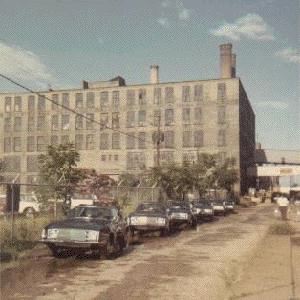
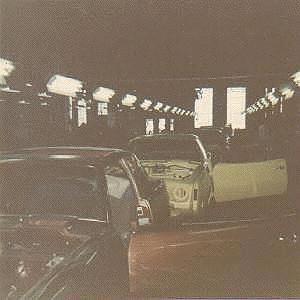
I became a Studebaker Avanti owner in 1972 and quickly found the Avanti
factory in South Bend to be a great source of parts, amusement and
inspiration. I was only ten years old when Studebaker halted Avanti
production in South Bend, but by the time I owned one I appreciated what was
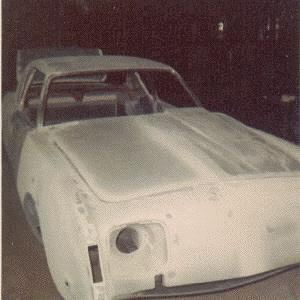
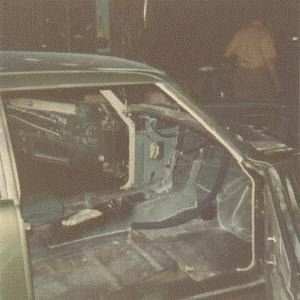
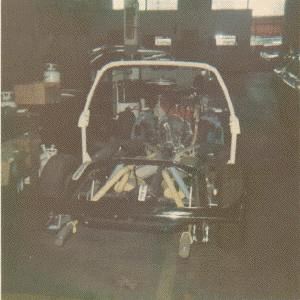
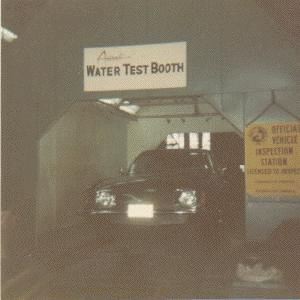
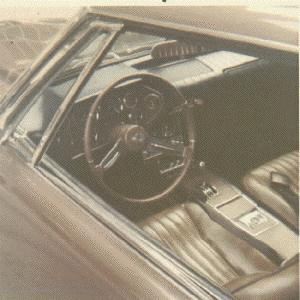
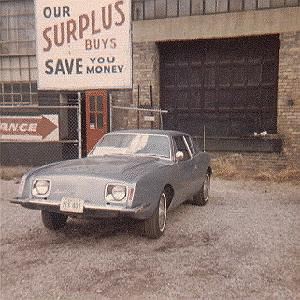
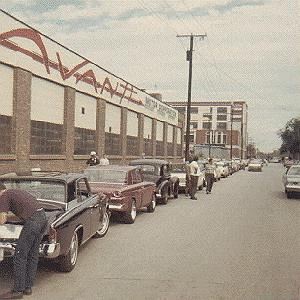
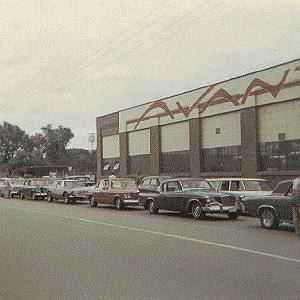
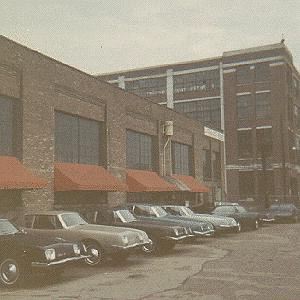
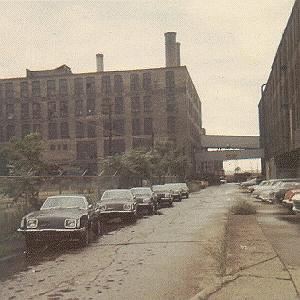
taking place and took the following photos of the Avanti III factory with my trusty Kodak Instamatic
camera at the Studebaker Drivers Club Meets between 1968 and 1972.
I really enjoyed my Avanti and would probably still own it if I lived in
Chicago or South Bend where they salt the streets every winter. However, in
1976 I moved to Orange County, California and a few years later, my mom moved
to Lone Pine, California. Whenever I visited my mom, I had to drive through
about 200 miles of the Mojave Desert. Although I already knew the Avanti was
a "hot" car, that term took on a whole new meaning during the summer.
Although I could have added air conditioning, that would have made it more
difficult to keep the engine cool, which was already enough of a problem in
a fiberglass car that had no radiator grille above the front bumper. There were times when I didn't
know what was going to melt first... me or the front end of the car. Finally,
I adopted "Windex air conditioning" which is a Windex bottle full of water
for misting my passengers and me during the trip though the desert. That had
a cooling effect and made the interior of the car feel more like a sauna than
a toaster oven.
In late 1979, a friend of mine named George Russell died in a motorcycle
accident. He had lived across the street from me in the same apartment complex
and operated a 1964 Studebaker Daytona with very bad brakes. He would pump
them three or four times whenever he wanted to stop the car and made evasive
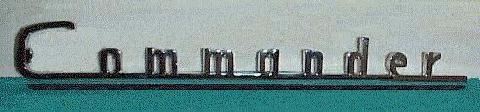
responses when I suggested that we fix them. I knew that he had a 1955
Commander because he showed me a photo of it, but the car was buried in his
two-car garage under a canvas tent and a lot of junk. In late 1979, I
noticed that he quit answering phone calls so I left a note on his
apartment door asking him to contact me. Shortly thereafter I received a
telephone call from his sister who informed me of the bad news. She had to
come to Anaheim from the San Jose area to dispose of his car and motorcycle
collection and accepted my offer of $700 for the Commander. The results of
that transaction are revealed by the photos below.
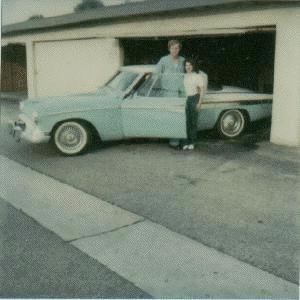
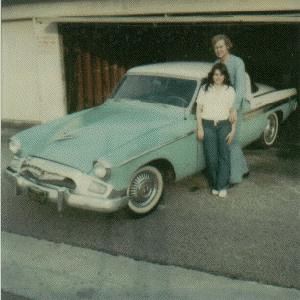
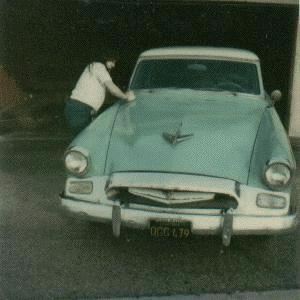
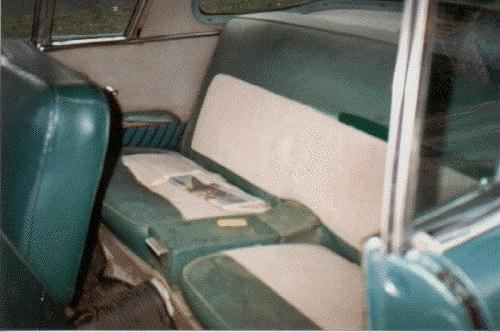
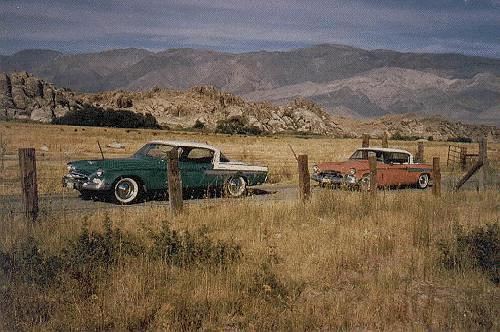
The first row of photos below were taken when my girlfriend, Nanette and I
first rolled the Commander out of the garage. She quickly began cleaning it
up while I began the important task of taking photos and offering
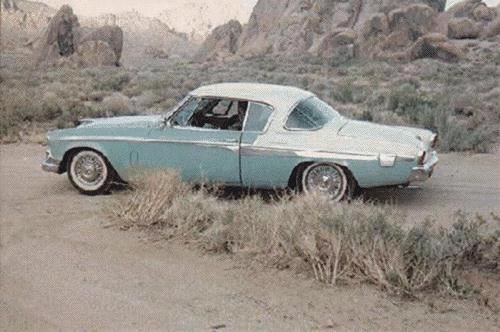
encouragement. Nan was a very good worker but when she was finished the car
still looked pretty bad as demonstrated by the second line of photos, which
were taken near the Lone Ranger's former hideout near Lone Pine.
Although the Commander didn't look very good, I got it running without too
much trouble. But soon I discovered that it wouldn't stop. When I went through
the brake system and took apart the master cylinder, I discovered why George
never drove the car... someone had put the master cylinder together with the
components in the wrong order. I suspect that George tried to fix the brakes
on the Commander, and having failed to accomplish that project, he never
attempted to fix the brakes on his Daytona.
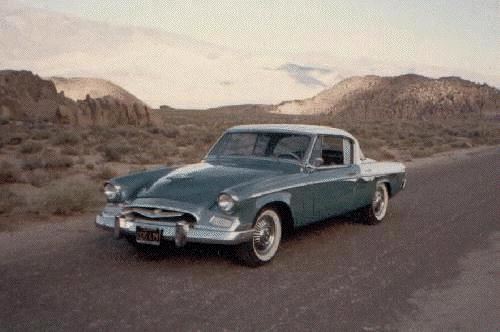
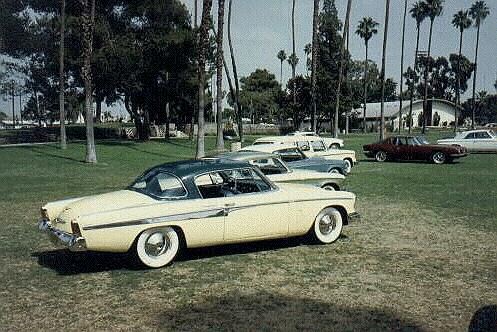
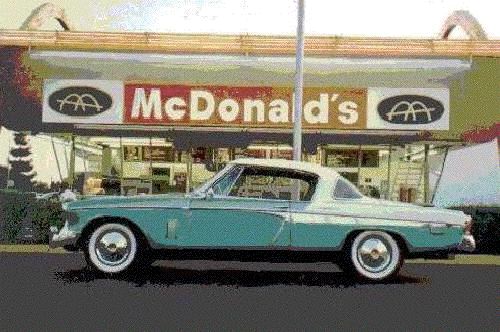
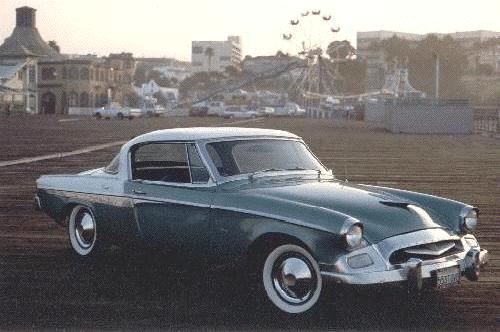
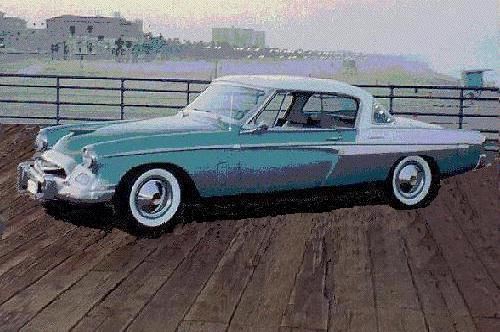
Despite the initial hassles, the Commander was a fine car. Someone had
ordered it from Burbank, California in February, 1955 and it was loaded with
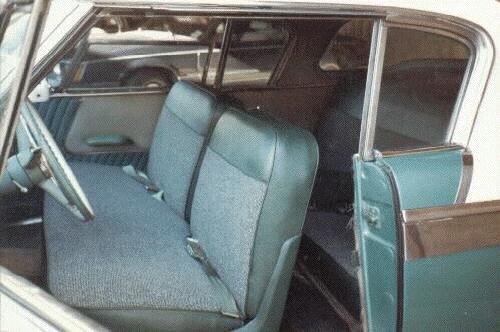
options, including power steering, power brakes, tinted glass, a radio, three-speed automatic transmission, four-barrel carburetor, electric seat and POWER
WINDOWS. I emphasize that last feature in the hope that someone will read
this page, remember a green and white Commander with POWER WINDOWS in the Los
Angeles area during the 1950's-1960's and let me know the identity of the first
owner(s). The power windows make it a rarity because very few 1955 Commanders
had that option.
Shortly after I got the Commander running, my dad came to visit me in Anaheim
as part of a business trip. He had to visit a military base up the Pacific coast
to the north. We took the Commander, mainly because it had a larger trunk
and more room than the Avanti. We went up Pacific Coast Highway through Big
Sur, then east through Yosemite and south to Bishop and Lone Pine. We had a
wonderful trip. Yosemite has miles of smooth curving roads that are ideal for
a tour in a green Studebaker V-8 hardtop with all the windows rolled down.
The old 259 cu.in. V-8 hummed along smoothly and made that sound I like so
much. Coming into Bishop we went through a rain shower which made the hood of
the car look new and green rather than the faded turquoise it had
become. On the final leg of the trip through Mojave I opened the little air
doors in the fenders, which kept the inside of the car nice and cool. By the
end of the trip I had decided to keep it.
I drove the Commander in its ragged condition until about 1981 when
I burned an engine bearing on the way to Lone Pine, where it would remain
until 1990. In 1982 I lost my job and was in my third year of law school. At
that time I had the Avanti, Commander, Messerchmitt, trailer for Fritz the Schmitt
and a motorcycle. Something had to go. Since the Avanti was the most valuable
vehicle of the lot, I sold it to a fellow Studebaker collector named Gordon Richmond from Calgary,
Canada.
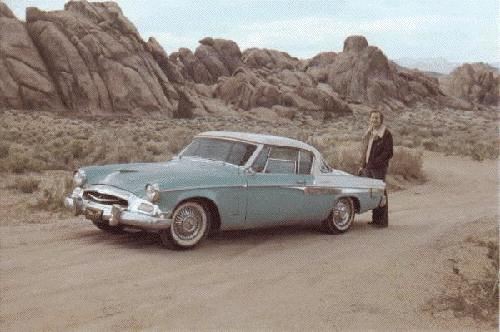
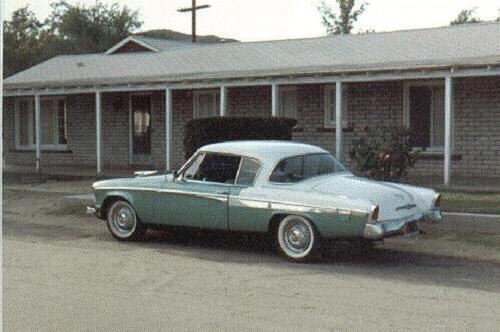
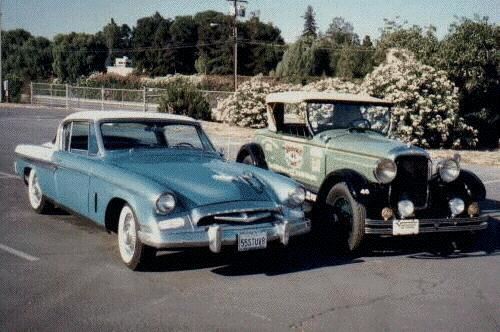
In 1990, I burned out the green Lark on another trip to Lone Pine and had to
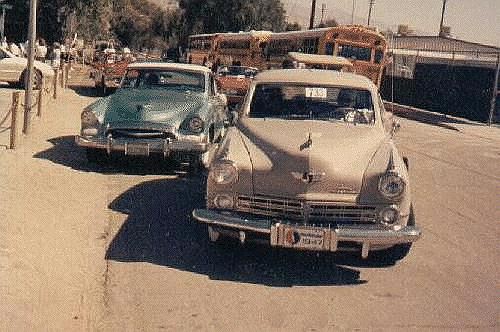
get the Commander back on the road again. The first four photos were taken
in the Lone Pine area. The man in the tan 1947 Studebaker Land Cruiser is
Sony Lindsey, who did most of the restoration work. After he finished my
Commander, he joined the Studebaker Club and bought the Land Criuser, then a
1962 GT Hawk and then an Avanti. Studebakers can be addictive.
From 1990 until the end of 1996, the Commander was my only four-wheel motor
vehicle, so I rode my BMW motorcycle most the time. That was acceptable,
except when it rained. I rode it anyway because I had spent a lot of effort getting the rust
out of the Commander and refused to drive it in the rain after the
restoration. By the end of 1996 I realized that both the Commander and I
were over forty years old. It was time to declare victory and quit
choosing between risking injury on the motorcycle, and rusting the Commander
whenever it rained. So in December 1996 I bought a new green and white Chevy
Cavalier convertible and put the Commander in semi-retirement.
I still love driving that old Commander, but drive it only when I can
enjoy every minute of the experience. Whenever September 30th falls on a
Friday, I celebrate James Dean Day and travel the same route to Cholame where
"the Rebel" met the Ford and the phone pole on September 30, 1955. I still
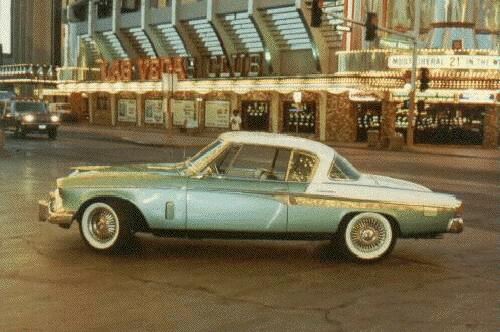
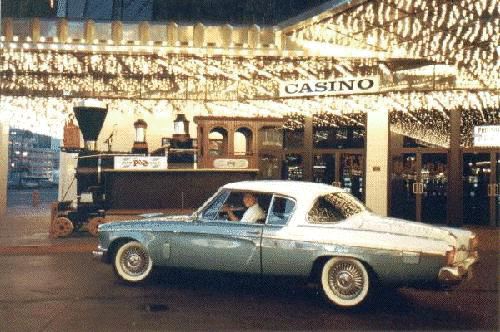
like to drive it to Las Vegas, when the weather is cool. On the way I leave
Toyota Land Cruisers in the wake of my dual exhausts for having the audacity
to steal a fine Studebaker name. And I like the way the Las Vegas lights
sparkle off the chrome at night.
As I said at the beginning of this website, some folks think of cars as
nothing more than a means from getting front "Point A" to "Point B." For
them, a car trip is wasted time. They can't experience the sights and
sounds of an old Studebaker V-8, a nice big steering wheel, a colorful long
hood or a little chrome airplane on the hood pointing the way down the road
to the next adventure. They know not what they miss.
 Seen The New Stude? ('58 Hawk - clip #2)